
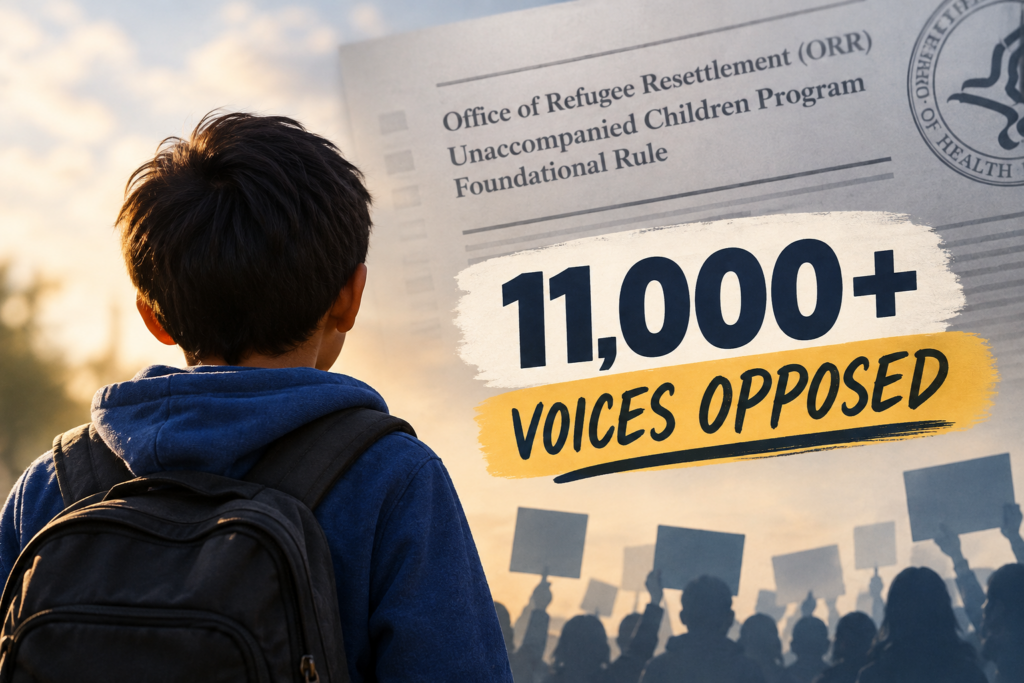
This summer, the federal government asked the public what it thought of a rule that would let Office of Refugee Resettlement (ORR) staff and contractors examine unaccompanied children’s bodies for tattoos and make it much harder for parents and relatives to bring them home. More than 11,000 people answered. We were proud to help lead the opposition.
In June, ORR proposed changes to the Unaccompanied Children Program Foundational Rule to authorize staff to examine children for “gang-related tattoos or other markings,” treating a tattoo as evidence a child is “a danger to themselves or others.” The same rule would codify sweeping new sponsor vetting requirements: eliminating most foreign-issued forms of identification that parents and relatives use to prove who they are, allowing only certain kinds of documents to prove household income, and expanding fingerprint-based background checks to every adult in a sponsor’s household.
The Young Center has spent more than two decades as independent Child Advocates for unaccompanied children in federal custody, and we know what rules like this do in practice. There is no reliable way to distinguish a coercive gang tattoo from one a teenager got to honor a grandparent. And strip-searching children for body markings is invasive, retraumatizing, and courts have held that it is unconstitutional absent actual evidence that a child is a risk to others. We have also watched similar sponsor vetting changes play out over the past year and a half through internal ORR guidance. The average time children spend in custody, separated from family and community, has skyrocketed from about 30 days to over six months.
When the comment period opened, we got to work. Along with our partners at the Center for Law and Social Policy (CLASP), Along with our partners at….we worked with advocates, lawyers, social media influencers, and anyone who wanted to voice their opinion and take action.
People showed up. More than 1,500 comments came in through the Young Center’s own portal, and more than 11,000 were filed across the full public docket opposing the rule, including parents, teachers, pediatricians, social workers, faith leaders, and people who simply believe that children deserve safety and family, not suspicion.
The Young Center also submitted our own expert comment, walking through why the rule conflicts with ORR’s legal obligation under the Trafficking Victims Protection Reauthorization Act (TVPRA) to place children in the least restrictive setting and release them to their family without unnecessary delay. Fifty organizations signed on with us, including legal service providers, medical associations, faith-based groups, and children’s rights advocates, standing together to tell ORR that its mission is to care for children, not police them.
We don’t know what ORR will do with this feedback. Agencies aren’t required to withdraw a rule just because the public opposes it, and this administration hasn’t hesitated to move forward with harmful rules anyway. But more than 11,000 voices against the cruel and suspicious treatment of children are now a part of public record.
To everyone who commented, called, or signed on: thank you. We’ll keep watching what ORR does next, and keep fighting for every child’s dignity, care, and swift path home. Learn more about the Young Center’s advocacy work, or support this work with a donation today.
By the Young Center Policy Team, in partnership with CLASP
